Eight ways to put a logo on a product, compared by what they work on, how they wear, and when each one is the wrong choice.
Eight ways to put a logo on a product, compared by what they work on, how they wear, and when each one is the wrong choice.
Key takeaways
- Choose the decoration method in this order: material first, artwork second, quantity and budget third.
- Anything that will be washed should be embroidered, engraved or woven; anything handled daily should be engraved or debossed; anything seen once can be printed.
- Setup (screens, digitizing, dies, loom programs) is charged once per design and reused on reorders, so the second run of the same logo costs less than the first.
- Fine lines and gradients need laser engraving, heat transfer or a woven label; embroidery fills in below about 5 mm letter height.
Most disappointing promotional products are not bad products. They are good products decorated the wrong way: a fine-line logo screen-printed where it fills in, a hoodie with a print that cracks after ten washes, a tumbler with a printed mark that the dishwasher takes off in a month. The product decision and the decoration decision are the same decision, and it helps to make them together.
We run all eight of the methods below, which means we have no reason to steer you toward one. Here is how we choose.
The eight methods compared
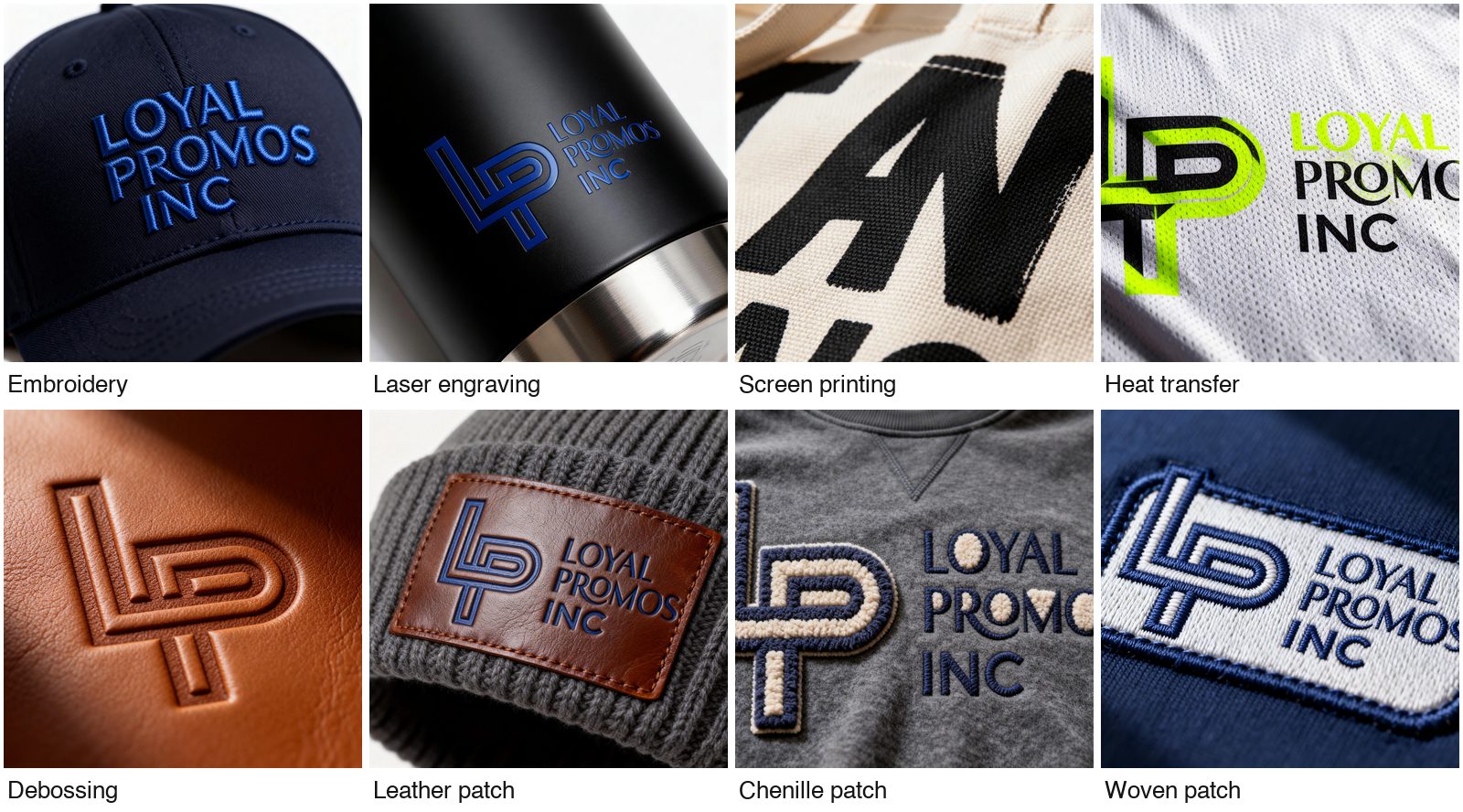
| Method | Works on | Detail it can hold | Durability | Cost driver | Choose it when |
|---|---|---|---|---|---|
| Embroidery | Fleece, polos, caps, bags, jackets | Medium; text above about 5 mm | Excellent; outlasts the garment | Stitch count; thread changes per color | Apparel that should look premium and last |
| Laser engraving | Stainless drinkware, metal pens, bamboo, leather, anodized aluminum | Very fine; hairlines and small text | Permanent | Engraving area and time | Drinkware, pens, awards, anything dishwasher-bound |
| Screen printing | Cotton and blended tees, totes, hi-vis vests, drinkware (rotary) | Good for solid shapes; halftones with care | Good; fades slowly with washing | Number of colors; one setup per color | Large runs, bold logos, tight unit cost |
| Heat transfer (incl. DTF) | Polyester, performance fabric, nylon, small or curved areas | Excellent; full color, gradients, photos | Good; can crack if over-stretched | Transfer size; minimal setup | Full-color art, low quantities, mixed sizes and names |
| Debossing / embossing | PU and leather notebooks, padfolios, coasters, boxes | Medium; clean shapes | Permanent | Die tooling (one-time) | Journals, gift boxes, executive items |
| Leather / PU patch | Caps, beanies, fleece, bags | Medium; the patch is engraved or debossed | Excellent | Patch die plus stitching | Outdoor, workwear and retail-style caps |
| Chenille patch | Varsity jackets, hoodies, caps, blankets | Low; letters and simple shapes | Excellent | Patch size and colors | Campus, team and spirit wear |
| Woven label | Garment hems, bag pockets, lanyards, blankets | Fine; small text and multiple colors | Excellent | Label size; one loom setup per design | A subtle brand mark, size tags, kit-wide consistency |
Step 1: match the method to the material
Start with the surface. Metal and bamboo want engraving. Cotton wants screen printing or embroidery. Polyester and performance fabrics want heat transfer or embroidery, because plastisol ink on polyester tends to let the fabric dye migrate through the print over time. Leather and PU want debossing. If a logo has to sit on four different materials in a kit, plan on three or four methods and one artwork file, sized once per item.
Step 2: match the method to the artwork
Fine lines, small text and gradients decide more than quantity does.
- Fine lines and tiny text: laser engraving, heat transfer or a woven label. Embroidery fills in below roughly 5 mm letter height; screen printing loses hairlines under about 0.5 pt.
- Photos and gradients: heat transfer (DTF, or dye-sublimation on white polyester). Screen printing can simulate them with halftones but needs an experienced separator.
- Solid one- or two-color marks: anything works, so let durability and cost decide.
- Metallic or textured looks: embroidery with metallic thread, foil heat transfer, or a leather patch.
Send vector artwork whenever you can. A logo that arrives as a small JPEG limits you to the methods that tolerate soft edges, and it will cost a redraw.
Step 3: match the method to quantity and budget
Every method has a setup step: screens, embroidery digitizing, a deboss die, a loom program, or a laser file. That setup is charged once per design and then reused on reorders, which is why a second run of the same logo is cheaper than the first and why we ask you to settle the artwork before ordering, not after.
- Under 100 pieces, or mixed sizes and names: heat transfer and laser engraving have the lowest setup, so they win.
- Hundreds of pieces with one to three colors: screen printing usually wins on unit cost.
- Anything meant to be worn for years: embroidery, a leather patch or a woven label, even if the unit cost is higher. PPAI's 2026 trend research found that buyers now rank durability (70%) first among the qualities they value; a cracked print is the fastest way to end up in a drawer.
Durability, tested the way recipients test it
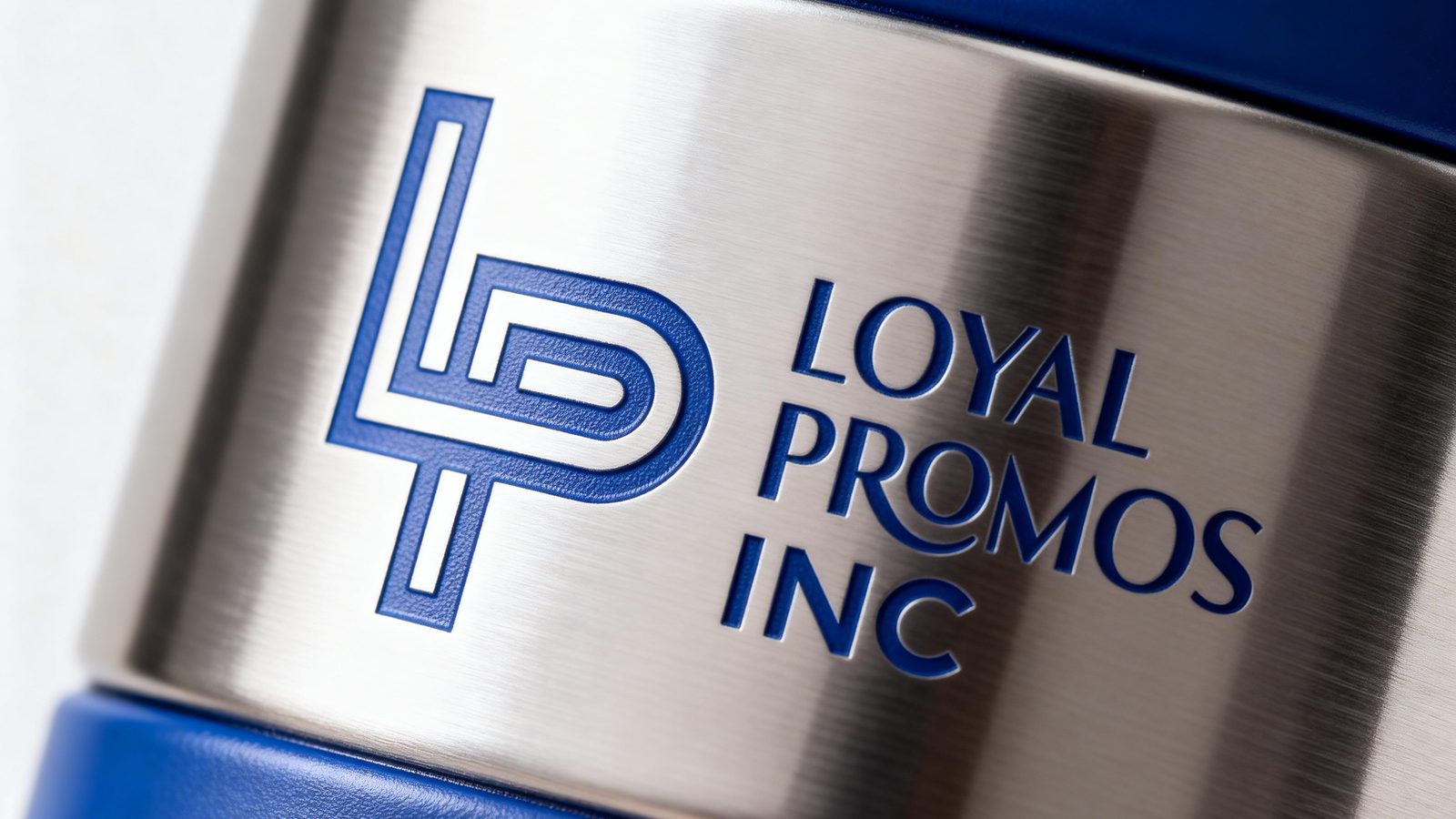
A useful rule: whatever will be washed should be embroidered, engraved or woven; whatever will be handled should be engraved or debossed; whatever will be seen once should be printed. Drinkware is the case where this matters most. Printed logos on stainless tumblers will eventually go through a dishwasher whatever the care card says. Engraving does not care.
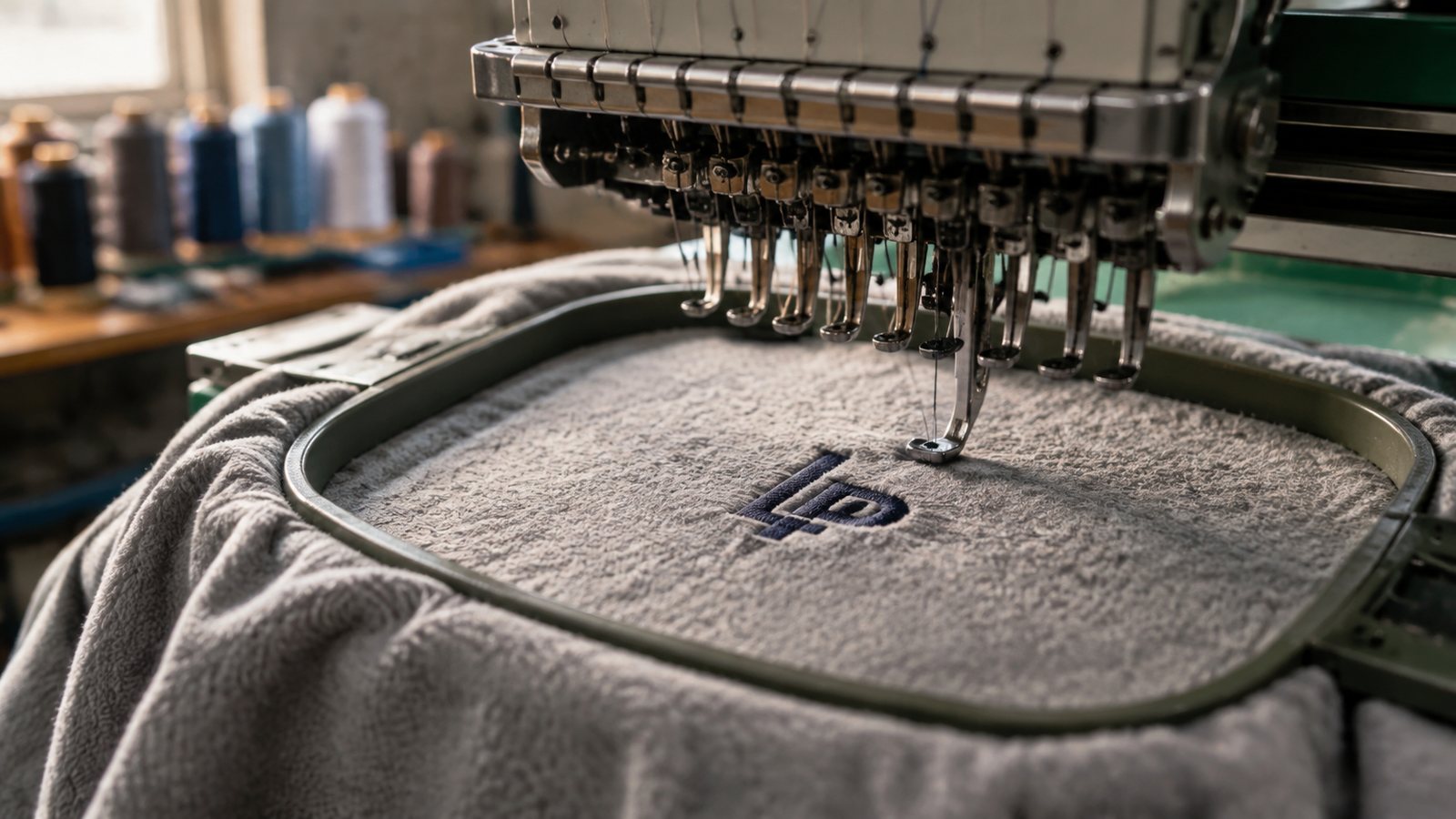
For fleece, the fabric weight sets the floor for decoration quality. A midweight hoodie in the 270 to 300 g/m² range (about 8 to 9 oz) takes embroidery cleanly without puckering; lighter fleece needs a backing and a smaller design. Manufacturer specification sheets list the weight; ask for it before choosing the method.
Mixing methods on one item
The best-looking pieces often use two methods: an embroidered left-chest mark with a heat-transfer inside neck label, a laser-engraved tumbler with a full-color printed sleeve, a debossed notebook with a woven bookmark ribbon. Print-on-demand and transfer techniques are increasingly used alongside traditional methods rather than instead of them, which is how you get personalization (a name per item) without giving up the durable main logo. (For a kit that uses four methods across six items, see New-Hire Welcome Kit: The Six-Item Base.)
Turnaround
Setup dominates lead time on small runs, production dominates on large ones. European suppliers reporting from the 2026 PSI trade show describe 24-hour decoration on stock items as an increasingly common market expectation, and U.S. buyers are pulling the same way. Ask for the method's real production time, not just the shipping time, and ask for a proof of the decorated item, not only the artwork. We return a proof for every item before production and a photo of the finished pieces before they ship.
What to send us
Your logo as a vector file, the products you are considering, the quantity range, and where the item will live: office, job site, gym, gift. With those four, we can recommend a method per item and quote setup and unit cost separately, so the trade-offs are on the page rather than in your inbox. Customize a single item to see the methods available on it, or request a quote for a run.
Frequently asked questions
Is embroidery or screen printing better for a hoodie?
Embroidery for a small left-chest mark that should last the life of the garment; screen printing for a large front graphic on a big run where unit cost matters most.
Which decoration method lasts longest on a stainless tumbler?
Laser engraving. It removes the coating to expose bare steel, so there is nothing to wear off in a dishwasher. Printed marks on drinkware fade with repeated washing.
What is the cheapest way to decorate a small order?
Heat transfer or laser engraving, because both have minimal setup. Screen printing and embroidery carry a per-design setup that only pays off across larger quantities.
Can one order use different decoration methods on different items?
Yes, and it is the normal way to build a kit: one artwork file, sized per item, with the method chosen for each material.
Sources
- PPAI Research, "2026 New-ish Trends," PPAI Magazine, January 2026 (durability, design and material rankings): https://www.ppai.org/media-hub/
- Print & Promo Marketing, "The New Standard: Print-on-Demand," March 2026 (mixed-method use): https://www.printpromomarketing.com/
- PSI Journal 3/2026 and PSI 2026 trade-show reporting (short-lead decoration): https://www.psi-network.de/
Ready to Put This Into Practice?
Published per-unit merchandise prices are binding at the listed quantity tiers. Decoration or imprint, applicable setup, rush-production, and shipping charges are confirmed in your written quote.
Request a Quote