Consumers care about sustainability, buyers ask about it rarely, and regulators now require it. Here is the paperwork that separates a claim from a fact, and how to ask for it.
Consumers care about sustainability, buyers ask about it rarely, and regulators now require it. Here is the paperwork that separates a claim from a fact.
Key takeaways
- 76% of U.S. consumers say sustainability influences whether they keep or use a promotional product, but only 33.3% of distributors say clients regularly ask for sustainable options.
- The pressure is coming from regulation instead: 34.4% of suppliers report more requests for documentation, testing, PFAS disclosure and ESG materials.
- Requests cluster in bags (21.6%), apparel (17.6%) and drinkware (17.6%), the categories most exposed to PFAS and packaging rules.
- The practical response is a short list of documents to request at the quote stage: material declaration, test reports, packaging statement, country of origin, and certificates where they apply.
Sustainability in promotional products used to be a preference. In 2026 it is increasingly a filing requirement. That shift changes what a buyer should ask a supplier for, and it favors suppliers who make the product themselves and can put the paperwork on the table.
What the research says
PPAI's Product Power 2026 consumer study found that 76% of consumers say sustainability influences whether they keep or use a product, 49.3% say it increases their trust in the brand, and more than 62% prefer products made from recycled or eco-friendly materials. Yet PPAI's 2025 distributor research found that only 33.3% of distributors say clients regularly ask for sustainable options, and 54.2% say ESG or product-origin questions are still rare. Suppliers report the same: only 17.5% say sustainability is a top buyer priority.
The number that is moving is a different one. Just over one third of suppliers (34.4%) report increased requests for documentation, testing, PFAS disclosure and ESG materials. PPAI's own prediction for 2026 is that sustainability momentum will be strongest where there is regulatory exposure, brand scrutiny or formal ESG documentation requirements.
In other words, the buyer who asks is usually not asking because of a preference. They are asking because a procurement policy, a state law or an ESG report requires an answer.
The three rule families that reach promotional products
This is a plain-language orientation, not legal advice. Rules vary by state and change often; check the current requirements for the states you ship to.
1. PFAS restrictions. PFAS are the "forever chemicals" used for water and stain resistance. A growing number of U.S. states, including California, Maine, Minnesota and New York, restrict or require disclosure of intentionally added PFAS in product categories such as apparel, textiles, food packaging and cosmetics, with phase-in dates through the late 2020s. For promotional products this touches water-resistant bags and jackets, performance apparel, umbrellas and some food-contact items.
2. Packaging extended producer responsibility (EPR). Several states, including Maine, Oregon, Colorado, California and Minnesota, have passed packaging EPR laws that make producers responsible for the cost of recycling the packaging they put on the market, with reporting obligations that phase in over several years. Your company may be the "producer" of record for branded packaging shipped to consumers in those states, which is why buyers now ask what a box, insert and poly bag are made of.
3. Existing product-safety and labeling rules. These predate the sustainability conversation but appear on the same checklist: CPSIA testing for items intended for children under 12, California Proposition 65 warnings, FDA food-contact requirements for drinkware, and battery and magnet shipping labels for electronics.
The documents worth asking for
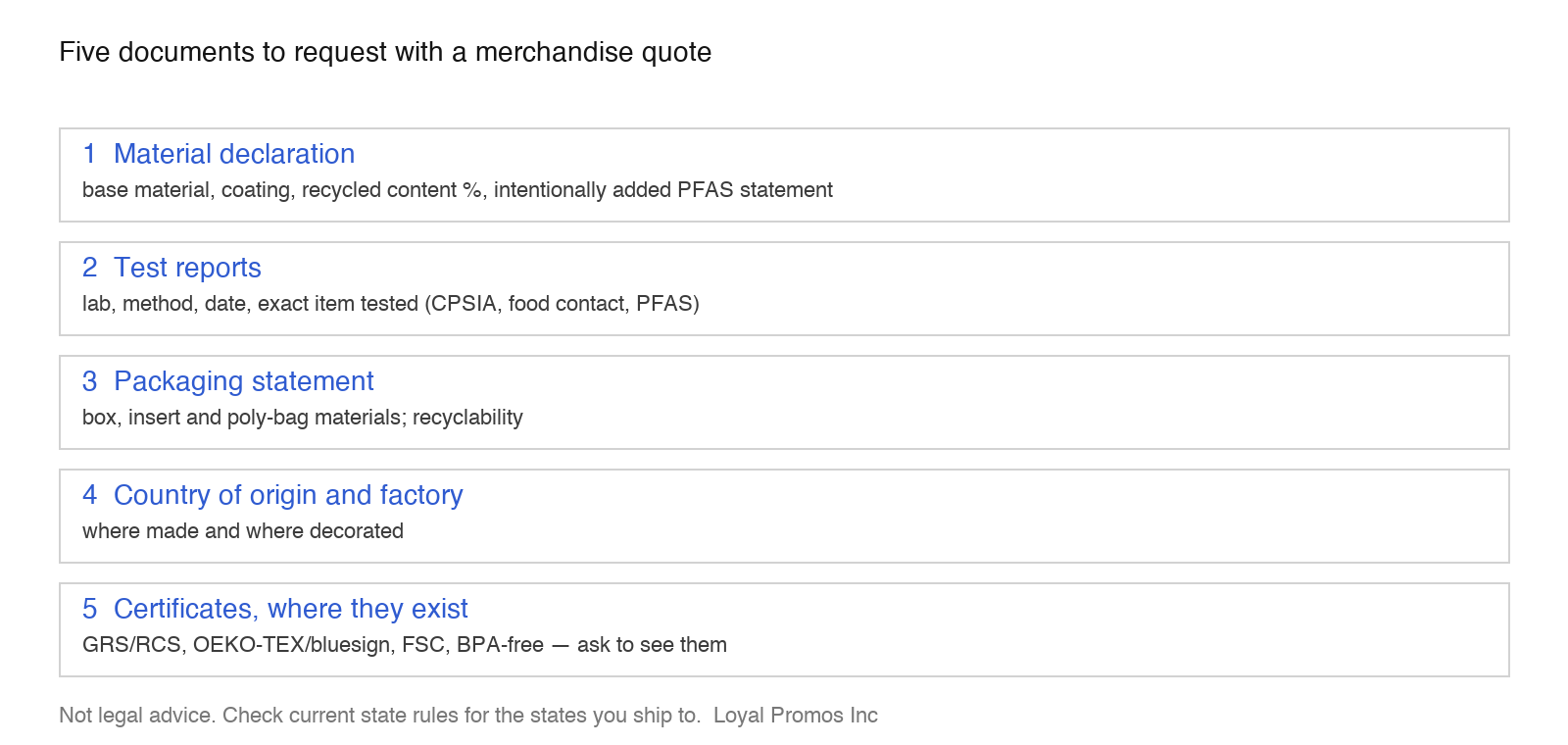
You do not need a sustainability department to ask the right questions. Five requests cover most policies:
| Request | What it should contain | When it applies |
|---|---|---|
| Material declaration | Base material, coating, recycled content by percentage, and a statement on intentionally added PFAS | Every item, especially bags, apparel, drinkware |
| Test reports | Lab name, test method, date, and the specific item or material tested | Children's items (CPSIA), food-contact drinkware, items shipped to states with PFAS rules |
| Packaging statement | Box, insert and poly-bag materials, recycled content, recyclability | Anything shipped to consumers or employees at home |
| Country of origin and factory | Where the item was made and where it was decorated | Government, education and healthcare purchasing; tariff planning |
| Certificates, where they exist | GRS or RCS for recycled content, OEKO-TEX or bluesign for textiles, FSC for paper and wood, BPA-free statements for drinkware | Only when the product actually carries the certificate; ask to see it rather than accept the logo |
Ask at the quote stage, not after production. Documentation that exists costs nothing to attach to a quote. Documentation that has to be created after the order ships costs weeks.
What a factory-direct supplier can and cannot promise
Because we make the products we sell, we hold the material sourcing for our own items and can obtain the test reports that apply to them; ask for them when you request a quote and we will tell you which ones exist for the item you have chosen and which would need to be commissioned. What no supplier can honestly promise is a blanket "eco-friendly" label. A recycled-polyester tote and a cotton tote are both sustainable claims with different paperwork behind them, and the paperwork is what a procurement reviewer will ask to see.
Two practical notes from our side of the process:
- Durability is a sustainability argument regulators and recipients both accept. PPAI's trend research lists durability and reusability among the areas where sustainability and brand perception reinforce each other. An engraved tumbler kept for years outperforms a recyclable giveaway thrown away in a week. (See How to Choose a Decoration Method for which decorations last.)
- Packaging is where the easiest wins are. Recycled paperboard, molded pulp inserts and paper tape are inexpensive, and a printed material statement on the box is the simplest way to answer an EPR question before it is asked. (See Custom Packaging: 5 Unboxing Details That Add Value.)
What to send us
Tell us which states the order ships to, whether recipients include children, whether any item touches food or drink, and whether your company has an ESG or procurement policy we should quote against. We will list the documents available for each item alongside the quote. Contact us with the policy, or request a quote and add the requirements in the notes.
Frequently asked questions
Do promotional products have to be PFAS-free?
It depends on the product category and the state. Several states restrict intentionally added PFAS in apparel, textiles and food packaging, with phase-in dates through the late 2020s. Ask for a written statement on intentionally added PFAS for water-resistant and performance items.
What is packaging EPR and does it apply to branded gift boxes?
Extended producer responsibility laws make the producer of packaging responsible for its end-of-life cost, with reporting obligations. Branded packaging shipped to consumers in states with EPR laws can fall under them, so buyers increasingly ask what the packaging is made of.
What documents prove a promotional product is sustainable?
A material declaration with recycled content by percentage, third-party test reports where a rule applies, and certificates such as GRS, RCS, OEKO-TEX or FSC when the product actually carries them. A logo on a website is not a document.
Do most buyers actually ask for this?
Not yet. Only about a third of distributors say clients regularly ask for sustainable options, but a third of suppliers already report rising documentation requests, concentrated in bags, apparel and drinkware.
Sources
- PPAI Research, "Sustainability Is Growing In Tandem With Compliance Demands," 2026 New-ish Trends, PPAI Magazine, January 2026 (Product Power 2026 consumer data; 2025 distributor and supplier research): https://www.ppai.org/media-hub/
- PPAI Research, "PPAI Sales Volume Estimate," PPAI Magazine, March 2026 (sustainable product sales): https://www.ppai.org/media-hub/
- State PFAS and packaging EPR statutes as summarized by the respective state environmental agencies; consult current state guidance before relying on any date or threshold.
Ready to Put This Into Practice?
Published per-unit merchandise prices are binding at the listed quantity tiers. Decoration or imprint, applicable setup, rush-production, and shipping charges are confirmed in your written quote.
Request a Quote