A monthly digest for merchandise buyers: what changed in promotional products in September 2026, where it comes from, and what it means for your next order.
A monthly digest for merchandise buyers: what changed, where it comes from, and what it means for your next order.
Key takeaways
- PPAI and Oxford Economics now size U.S. branded merchandise at $174 billion, while the distributor sales figure most buyers know is still about $27 billion. Use the number that fits your comparison.
- Carrier peak programs started in late September, residential surcharges step up from late October, and FedEx list rates rise an average of 5.9% in January 2027, so home-delivered gifts cost the most to ship. Order as early as you can and ship in bulk where possible.
- PFAS rules keep moving. A court blocked New Mexico's product label, but its reporting and restrictions stand, and Minnesota's first reports came due September 15.
- Two power bank recalls and a button-battery recall point to where safety risk sits in common giveaways. Ask for battery test documents and keep model numbers on file.
Industry Watch is a short monthly page. Each item gives what happened in our own words, why it matters if you buy branded merchandise, and where the information comes from. We do not reproduce the source material; the links go to the publishers.
1. PPAI puts a number on the whole branded merchandise economy
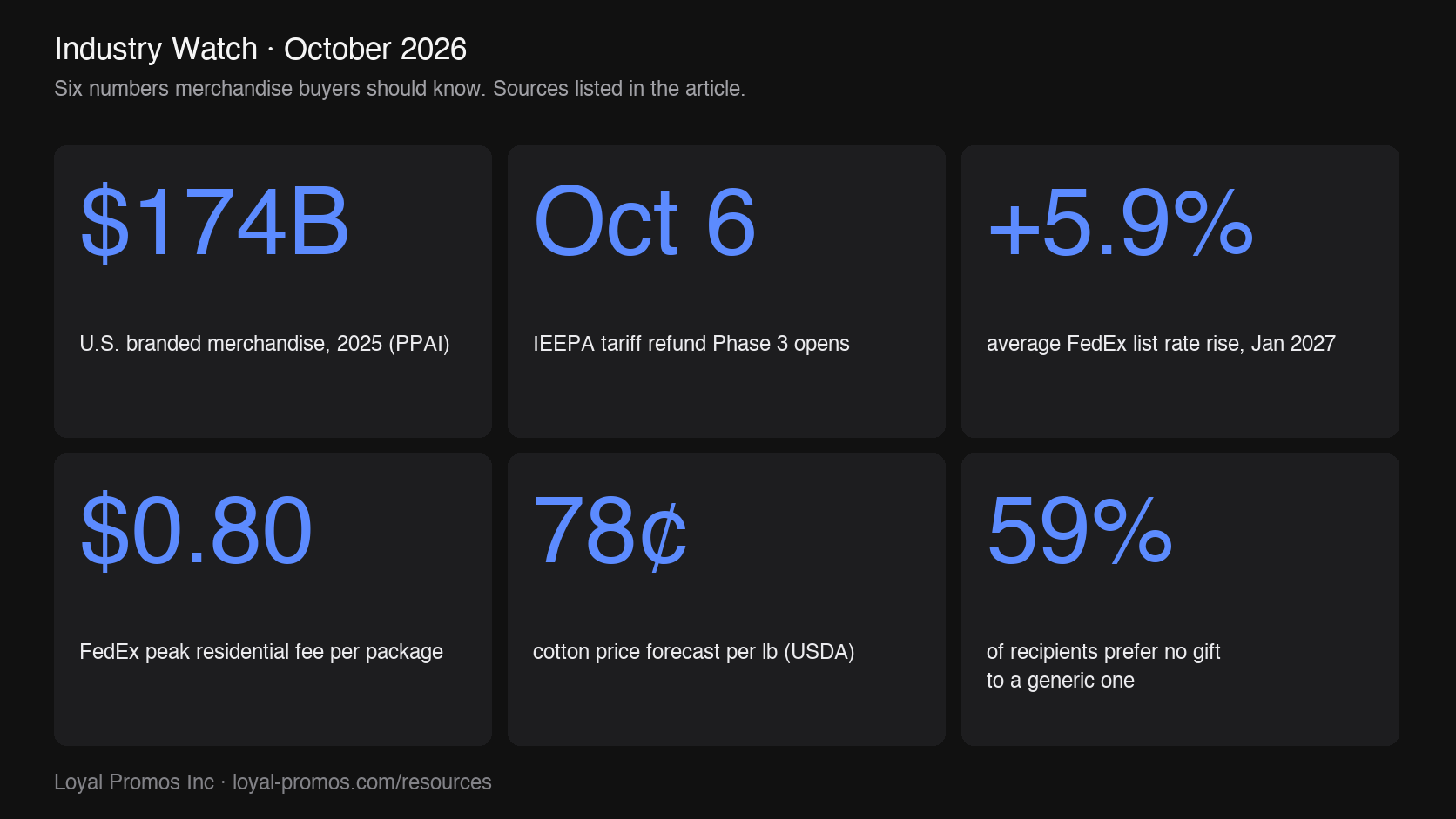
On September 8, PPAI released a study it commissioned from Oxford Economics that counts far more than promo distributor sales, including licensed goods, workwear, retail-branded items, creator merch and recognition gifts. It puts global spending in 2025 at $338.3 billion, supporting $472.3 billion in GDP (PPAI, September 8). A follow-up article on September 22 sizes the U.S. market at $174 billion, made up of $50 billion in promotional products and $124 billion in licensed merchandise, and says promotional products equal about 13% of U.S. advertising spend (PPAI, September 22). The same article notes that traditional distributor sales remain about $27 billion of the $50 billion promotional total.
For buyers: if you are making the case for a merchandise budget against other media, pick the figure that matches your comparison and name its source. The $174 billion covers everything branded, the $50 billion covers promotional products bought through every channel, and about $27 billion is what goes through distributors. (Distributor numbers: Industry Watch, September 2026 and The U.S. Promo Industry in Numbers.)
2. Tariff refunds reach Phase 3 on October 6
In a September 15 court filing, CBP said Phase 3 of its process for refunding tariffs imposed under the International Emergency Economic Powers Act (IEEPA) opens October 6, following Phase 1 on April 20 and Phase 2 on June 29 (Thompson Hine). Phase 3 is open only to importers of record that are plaintiffs in a pending Court of International Trade case, a limit that is still being contested in court, and those that gave CBP their importer-of-record number by July 30 can start on October 6. CBP reported about $134.7 billion in potential and certified refunds accepted into its refund system and roughly $122 billion, including interest, certified and passed to the Treasury for payment, while about 20,184 refunds worth $1.3 billion were on hold because the importer had not supplied bank details (C.H. Robinson).
For buyers: refunds go to the importer of record, which for most promotional orders is the supplier or distributor that imported the goods, not the company that bought the finished items. If duties or surcharges on your orders change, ask your supplier how it is handling tariff changes. Quotes reflect the duties in effect when they are issued. This is general information, not legal advice.
3. PFAS: New Mexico's label blocked, Minnesota's first reports due
On September 16, a federal court in New Mexico preliminarily blocked the state's required flask-shaped "PFAS" label for products made after January 1, 2027, finding that the trade groups' free-speech challenge is likely to succeed (Beveridge & Diamond; Source NM via PFAS Project). The rest of the law stands, with reporting due January 1, 2027, product restrictions starting in 2027 and 2028, and a broad ban from 2032, subject to exemptions. In Minnesota, first PFAS-in-products reports were due September 15, with a one-time $800 fee per manufacturer and a December 14 deadline for companies that requested an extension by August 16 (Minnesota Pollution Control Agency). Connecticut's labeling and notification rules for listed product types, including apparel and cookware, took effect July 1, 2026, a sales ban on intentionally added PFAS in covered categories starts January 1, 2028, and the state updated its PFAS in Products page on September 23 (Connecticut DEEP).
For buyers: the September issue said PFAS rules continue to phase in; this month there is a court ruling and a live deadline. Minnesota's definition of manufacturer reaches past the factory. It includes a company that contracts for a product made under its own brand or label and, when the brand owner has no U.S. presence, the importer or first domestic distributor. If your company sells or distributes branded goods in Minnesota, read the state's reporting page or ask counsel whether it applies. For water-resistant bags, jackets, umbrellas and performance apparel, ask the supplier for a written statement on intentionally added PFAS. General information, not legal advice. (Checklist: Sustainability Is Now Paperwork.)
4. September recalls hit power banks and light-up novelties
On September 3, Truststone Group recalled about 32,400 XO Poppy Power Trip magnetic wireless power banks sold at TJX and Marshalls because the battery can overheat and catch fire (CPSC). On September 24, about 21,380 NEWDERY power banks sold on Amazon were recalled after nine reports of explosion or ignition, one of them a fire that caused $2 million in property damage (CPSC). The same day, ABC Trading recalled about 43,674 light-up glasses, headbands and ties whose button-cell battery compartments children can open easily, which violates the mandatory toy standard (CPSC).
For buyers: all three recalls involve products sold at retail, but power banks and light-up items turn up in many kits and event bags. Ask for the battery's safety test documents, keep a record of the model numbers you hand out so you can check future recalls, and for anything a child might receive, ask for a secured battery compartment and a Children's Product Certificate. General information, not legal advice.
5. Peak parcel fees start and FedEx sets 2027 rates
Carrier peak-season programs began September 27 at UPS and September 28 at FedEx, with USPS peak pricing from October 4. Residential surcharges follow from October 25 at UPS and October 26 at FedEx, and the highest residential ground charges, $0.75 per package at UPS and $0.80 at FedEx, apply from late November to late December (EasyPost). FedEx will raise U.S. list rates an average of 5.9% on January 4, 2027, lift its residential delivery charge from $6.95 to $7.35, and add a $25 fee for paper trade documents from January 18 (Supply Chain Dive).
For buyers: gifts shipped one by one to home addresses between late November and late December carry the highest per-package fees, and 2027 programs start from a higher base rate. Ask for freight to be quoted as its own line, compare one bulk shipment with individual drop-ships, and for any imported item ask whether factory holiday closures affect the production date. (Kit planning: New-Hire Welcome Kit: The Six-Item Base.)
6. USDA raises its cotton price forecast
USDA's September 11 crop report cut its 2026/27 U.S. cotton crop forecast by 3% to 13.2 million bales and lowered projected ending stocks by 10% to 3.60 million bales (USDA WASDE-675). It raised the projected season-average upland farm price to 78 cents per pound, up from 75 cents in August and against an estimated 62.0 cents for 2025/26. USDA also trimmed projected U.S. mill use to 1.50 million bales, noting that the domestic textile base keeps shrinking.
For buyers: raw cotton is only part of what a finished T-shirt costs, but a higher price outlook can add pressure on blank apparel prices going into 2027. For spring apparel programs, confirm blank prices early and ask how long a quoted price holds. (Options: browse products.)
7. Recipients want thoughtful gifts, and the holiday season will be busy
A Harris Poll survey commissioned by corporate gifting company Packed with Purpose, released September 24, polled 2,007 U.S. adults in July, 1,133 of whom had received a corporate gift (PR Newswire). Among recipients, 59% said they would prefer no gift to a generic one, 85% put the thought behind a gift ahead of its price, and gifts that give back to a cause or do some social good were linked with 3.2 times higher odds of a stronger relationship. Separately, Deloitte forecasts November-to-January retail sales up 4.0% to 4.8%, reaching $1.70 trillion to $1.71 trillion, with e-commerce up 7.5% to 8.4% (Deloitte, September 10).
For buyers: the poll comes from a company that sells gifts, so read it with that in mind, but it points the same way as PPAI's consumer research covered last month. Put planning time into fit rather than a bigger per-unit budget; the poll suggests a smaller, useful item with a short note can do more than a larger generic one. A busy retail season can also compete for decoration capacity and parcel space, so the earlier you order December gifts, the better. (Five patterns: What Award-Winning Promo Campaigns Have in Common.)
What this means for your next order
- Order December gifts as early as you can. Carrier peak programs have started, residential fees rise from late October, and decoration schedules can get busier as the season goes on.
- Ask for paperwork with the quote. Request a PFAS statement for coated or water-resistant items and battery test documents for power banks and light-up items, and keep the model numbers.
- Read the freight and tariff lines. Ask for freight quoted separately on 2027 programs, and ask your supplier how it is handling tariff changes.
Request a quote for your year-end or 2027 program, or browse products to start a shortlist.
Frequently asked questions
Why do the $174 billion and $27 billion figures differ so much?
They measure different things. PPAI's September study counts all U.S. branded merchandise, including $124 billion in licensed goods, while about $27 billion is the share of promotional products sold through distributors. The source is PPAI's September 22 article.
Will I get a refund for tariffs I paid on promotional products?
CBP pays refunds of IEEPA tariffs (duties imposed under the International Emergency Economic Powers Act) to the importer of record, which for most finished promotional products is the supplier or distributor, not the end buyer. For questions about tariff changes on your orders, ask your supplier how it is handling them. For the process itself, see Thompson Hine's summary. This is general information, not legal advice.
Does the New Mexico ruling mean PFAS rules no longer apply?
No. The court blocked only the label requirement for now. New Mexico's reporting deadline and product restrictions remain, and other states, including Minnesota and Connecticut, have their own rules. See Beveridge & Diamond's summary and the MPCA reporting page.
Sources
- PPAI, "PPAI Releases Landmark Study Showing Branded Merchandise Supports A $472 Billion Global Economic Footprint," September 8, 2026: https://www.ppai.org/media-hub/ppai-releases-landmark-study-showing-branded-merchandise-supports-a-472-billion-global-economic-footprint/
- PPAI (John Corrigan), "Inside The $174 Billion US Branded Merchandise Market," September 22, 2026: https://www.ppai.org/media-hub/inside-the-174-billion-us-branded-merchandise-market/
- Thompson Hine SmarTrade, "CBP Confirms October 6, 2026 Launch of Phase 3 of the IEEPA Tariff Refund Process," September 16, 2026: https://www.thompsonhinesmartrade.com/2026/09/cbp-confirms-october-6-2026-launch-of-phase-3-of-the-ieepa-tariff-refund-process/
- C.H. Robinson, "CBP Reports Major Progress on IEEPA Refunds; CAPE Phase 3 Launches October 6," September 17, 2026: https://www.chrobinson.com/en-us/resources/insights-and-advisories/client-advisories/2026q3/09-17-26-cbp-cape-phase-3-ieepa-refunds/
- Beveridge & Diamond, "Federal Court Enjoins Sweeping New Mexico PFAS Labeling Obligations," September 17, 2026: https://www.bdlaw.com/publications/federal-court-enjoins-sweeping-new-mexico-pfas-labeling-obligations/
- PFAS Project (republishing Source NM), "Federal judge sides with manufacturers, blocks New Mexico's PFAS labeling rule," September 22, 2026: https://pfasproject.com/2026/09/22/federal-judge-sides-with-manufacturers-blocks-new-mexicos-pfas-labeling-rule/
- Minnesota Pollution Control Agency, "Reporting PFAS in products": https://www.pca.state.mn.us/air-water-land-climate/reporting-pfas-in-products
- Connecticut Department of Energy and Environmental Protection, "PFAS in Products," updated September 23, 2026: https://portal.ct.gov/deep/p2/pfas-in-products
- U.S. Consumer Product Safety Commission, Truststone Group XO Poppy Power Trip power bank recall, September 3, 2026: https://www.cpsc.gov/Recalls/2026/Truststone-Group-Recalls-XO-Poppy-Power-Trip-Magnetic-Wireless-Power-Banks-Due-to-Fire-and-Burn-Hazards-Sold-Exclusively-at-TJX-and-Marshalls-Stores
- U.S. Consumer Product Safety Commission, NEWDERY power bank recall, September 24, 2026: https://www.cpsc.gov/Recalls/2026/NEWDERY-Power-Banks-Recalled-Due-to-Fire-and-Burn-Hazards-Risk-of-Serious-Injury-Sold-on-Amazon
- U.S. Consumer Product Safety Commission, ABC Trading light-up children's toys recall, September 24, 2026: https://www.cpsc.gov/Recalls/2026/ABC-Trading-Recalls-Light-Up-Childrens-Toys-Due-to-Risk-of-Serious-Injury-or-Death-from-Battery-Ingestion-Violate-Mandatory-Standard-for-Toys
- EasyPost, "Peak season surcharges 2026," September 7, 2026: https://www.easypost.com/blog/peak-season-surcharges-2026/
- Supply Chain Dive, "FedEx preps 5.9% rate hike, surcharge increases for 2027," September 21, 2026: https://supplychaindive.com/news/fedex-preps-59-rate-hike-surcharge-increases-for-2027/830903
- USDA World Agricultural Outlook Board, WASDE-675, September 11, 2026: https://www.usda.gov/oce/commodity/wasde/wasde0926.pdf
- Packed with Purpose and The Harris Poll, press release via PR Newswire, September 24, 2026: https://www.prnewswire.com/news-releases/59-of-corporate-gift-recipients-would-rather-get-nothing-than-something-that-feels-generic-new-packed-with-purposeharris-poll-finds-302888738.html
- Deloitte, "Deloitte forecasts holiday retail sales," September 10, 2026: https://www.deloitte.com/us/en/about/press-room/deloitte-forecasts-holiday-retail-sales.html
Ready to Put This Into Practice?
Published per-unit merchandise prices are binding at the listed quantity tiers. Decoration or imprint, applicable setup, rush-production, and shipping charges are confirmed in your written quote.
Request a Quote